Safety, suitability & support

The page that matters most before you decide anything.

Hypnotherapy is not appropriate for every person or every concern, and pretending otherwise would not be doing anyone a service. This page sets out how suitability is considered, when other forms of professional care are more important, and what you are entitled to ask before agreeing to anything.

A group of people each holding a wooden jigsaw piece towards the centre of a circle.
Support is rarely one thing. Most people are best served by several sources working together.

Section 01

Individual suitability.

Suitability is a question about fit, not about worth. It depends on the specific person and the specific concern, and it is properly assessed in conversation rather than assumed from a description on a website. Several things are considered.

  • Individual circumstances

    What is happening in your life now — including stability, safety, responsibilities and pressures — shapes what is sensible to attempt and when.

  • Current concerns

    Some concerns fall clearly outside what hypnotherapy can address and require medical or mental health assessment instead. Others may be reasonable to explore alongside existing care.

  • Personal history

    Previous experiences, including previous experiences of therapy, are relevant — what helped, what did not, and what you would not want repeated.

  • Existing professional support

    If you are under the care of a doctor, psychiatrist, psychologist or counsellor, that relationship takes precedence and should be discussed openly rather than worked around.

  • Goals and expectations

    What you are hoping for matters. Where an expectation cannot realistically be met, it is better to say so at the outset than to proceed and disappoint.

If the answer is no

Where hypnotherapy does not appear to be the right approach for your situation, that will be said plainly. Being told that something is not appropriate for you is not a rejection — it is the point of asking the question, and it saves time, money and disappointment.

Section 02

When other support may be important.

Some individuals may benefit from assessment or support from professionals whose training and scope of practice differ from a hypnotherapist's. Recognising that is a normal part of responsible practice.

Medical professionals

Physical symptoms — including sleep problems, fatigue, chest discomfort, digestive change, pain or unexplained bodily symptoms — should be assessed by a doctor. Assuming a psychological cause without medical assessment risks missing something treatable.

Mental health professionals

Psychiatrists, clinical psychologists and other qualified mental health practitioners are the appropriate people to assess and diagnose mental health conditions and to advise on evidence-based treatment where it is indicated.

Appropriately qualified specialists

Depending on circumstances, other specialists may be relevant — for example those working in addiction, eating difficulties, child and adolescent care, neurology or specific trauma-focused treatments.

If you are concerned about immediate safety

If you are worried about your own immediate safety or the safety of someone else, please contact local emergency services or an appropriately qualified healthcare professional without delay. A hypnotherapy enquiry is not an emergency service and should not be relied on as one.

No helpline numbers are listed on this website, because publishing numbers that have not been verified as current and appropriate for your location could do more harm than good. Your doctor, a local hospital, or emergency services can direct you to the right service.

Section 03

Medication.

Do not start, stop or change prescribed medication without consulting an appropriately qualified prescribing healthcare professional.

This is stated without qualification because the consequences of getting it wrong can be serious. Stopping some medications suddenly can cause withdrawal effects or a return of symptoms; changing a dose without supervision can be dangerous. Decisions about medication belong with the professional who prescribed it.

A hypnotherapist is not a prescriber, does not assess medication, and should never advise you to reduce or discontinue anything you have been prescribed. If you have questions or concerns about a medication — including side effects, or a wish to come off it — those questions belong with your prescriber, who can advise on whether and how that can be done safely.

Being on medication does not in itself rule out considering hypnotherapy. It is simply information that forms part of a full picture, and it is worth mentioning at the outset.

A healthcare professional going through a health check form with a patient, with medication packs on the desk.
Questions about prescribed medication belong with the professional who prescribed it.

Section 04

Memory and hypnosis.

This section exists because the claim that hypnosis can reliably uncover forgotten memories is both widespread and unsupportable — and because acting on it can cause real harm.

Memory is reconstructive, not a recording

Human memory does not work like a video file that can be located and replayed. Recollection is reconstructive: each time something is recalled it is assembled again, and it can be influenced by mood, expectation, subsequent information, and by how a question is asked. This is true of ordinary memory, in ordinary circumstances, without anyone intending it.

A state of focused attention and heightened suggestibility does not improve that situation. It can increase confidence in a recollection without increasing its accuracy — which is a particularly unhelpful combination, because confidence is what people use to judge whether a memory is real.

What this means in practice

Hypnosis should not be presented as a method for accurately recovering forgotten memories, and memory recovery is not something to pursue as a therapeutic goal. The potential consequences of doing so include distress, damaged relationships, and confident belief in events that may not have occurred as recalled.

Stated clearly

No claim is made on this website that hypnosis can accurately uncover forgotten memories. Memory recovery is not encouraged, and it is not offered as a service.

What can be worked with instead

Useful work does not depend on establishing what happened. It can focus on how you are affected now, on the responses you have noticed, on comfort and settling, and on goals you have chosen — none of which require a reconstructed account of the past.

Many people find this a relief. It removes the pressure to produce a coherent story before anything can be addressed.

Uncertain memories

If you have partial or uncertain recollections that concern you, that is worth discussing with an appropriately qualified mental health professional rather than attempting to resolve through hypnosis.

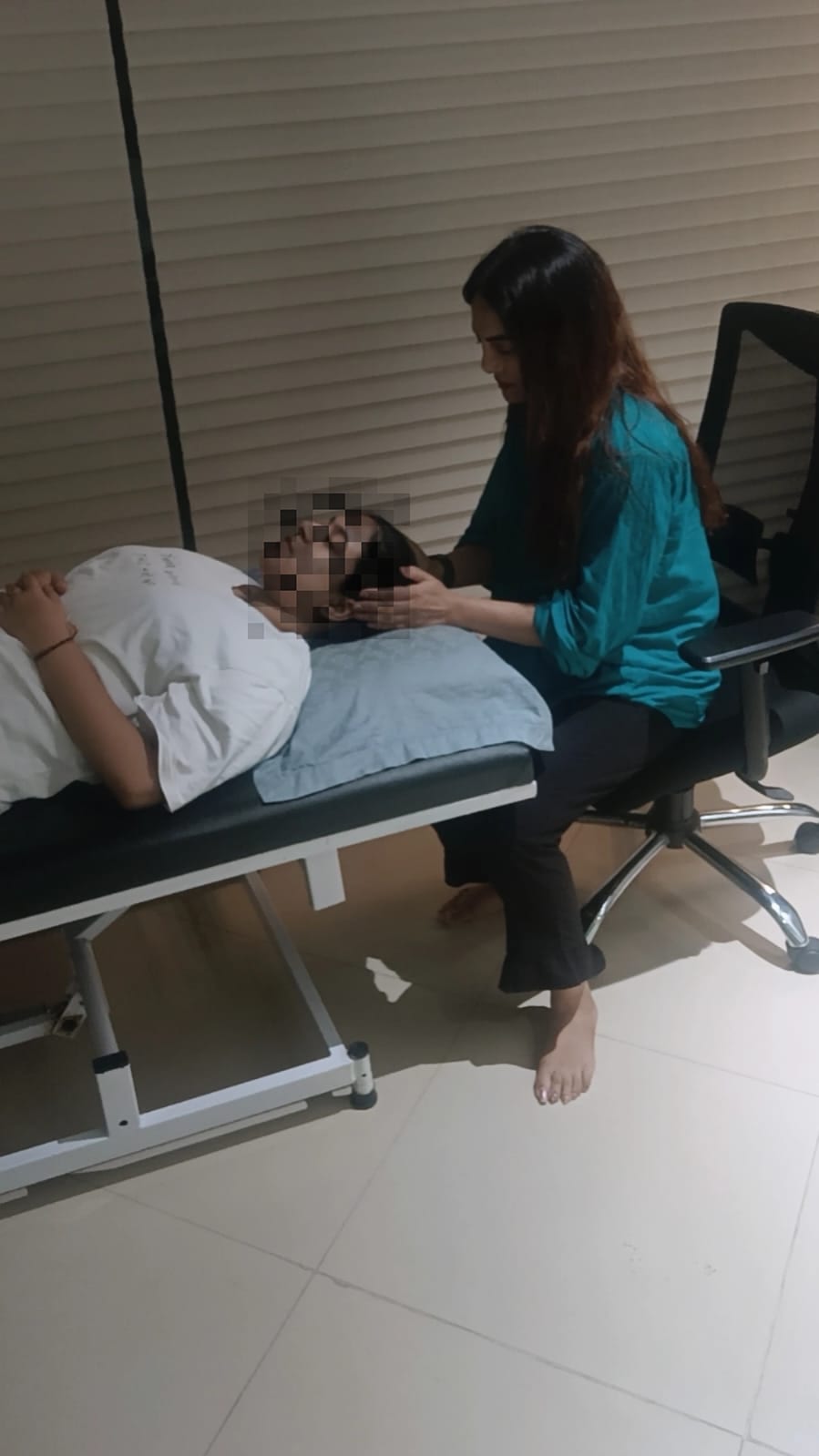
Vibha Jain seated beside a client resting on a treatment couch during a session in a quiet room.
A session in practice. The client's face has been obscured to protect their privacy.

Section 05

Informed decision-making.

An informed decision is one made with enough information to be able to decline. That applies here as it does anywhere else in healthcare, and you are encouraged to use it.

  • Ask questions. About the approach, the practitioner, the process, the limits and the cost. Nothing on that list is unreasonable.
  • Understand the process. What happens in a session, what is recorded, how your information is handled and who has access to it.
  • Discuss concerns. Including scepticism. A practitioner who welcomes doubt is generally a better sign than one who deflects it.
  • Consider fit for your circumstances. Not whether it works in general, but whether it makes sense for you, now, given everything else.
  • Take your time. There is no reason to decide during a first conversation, and no pressure to.

A short checklist before agreeing to anything

  1. Do I understand what is being proposed, in plain terms?
  2. Do I know what it will not do?
  3. Have I mentioned my existing medical or mental health care?
  4. Do I know how to stop, and am I confident that stopping will be accepted?
  5. Is there anything I am agreeing to because I feel I should rather than because I want to?

In summary

The important points, in one place.

  • The information on this website is intended for general educational purposes and should not be considered a substitute for medical, psychiatric, psychological or emergency care.
  • Hypnotherapy may not be suitable for every individual or every concern. Suitability depends on personal circumstances and should be considered individually.
  • Do not start, stop or change prescribed medication without consulting an appropriately qualified prescribing healthcare professional.
  • Only appropriately qualified professionals can assess and diagnose specific mental health conditions.
  • Hypnosis should not be presented as a reliable way to recover forgotten memories, and memory recovery is not encouraged here.
  • Trauma-focused treatment may involve different evidence-based approaches depending on the individual's needs.
  • Responses to therapy differ, and no outcome is guaranteed.

Begin with a conversation

Suitability is discussed before anything is arranged.

If you would like to talk through whether this approach makes sense for your circumstances, you are welcome to get in touch. An honest answer is more useful than an appointment.